


Australia’s cash rate has reached an 18-year high, but a divided Reserve Bank board faces an increasingly difficult question: how much economic weakness is necessary to bring inflation under control?
The RBA has raised the official cash rate by 25 basis points to 4.85%, its fifth hike this year and marking an 19-year high, the highest level since November 2008.
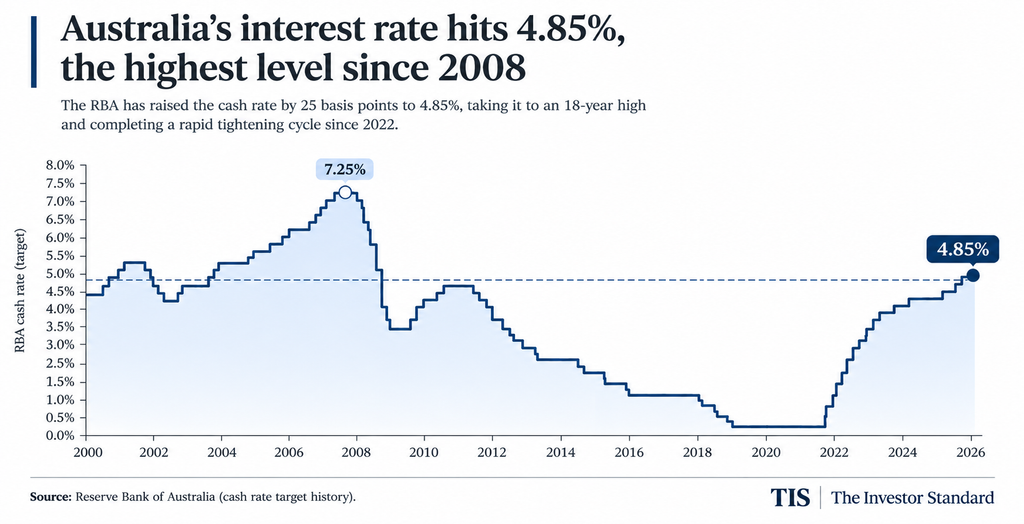
Announced on Tuesday, 3 November, the decision was in a 6-3 split. The split highlights the increasingly difficult trade-off confronting policymakers as persistent inflation collides with slowing economic activity and household budget pressures.
The increase itself was widely anticipated. A bigger issue may be the outlook following it. Inflation is expected to remain elevated for longer even as growth weakens and unemployment rises.
For households, the decision represents another increase in borrowing costs and mortgage payments. For investors, it raises a broader question about how much more can the the Australian economy absorb further tightening without experiencing a more pronounced downturn.
Inflation Remains the RBA’s Greatest Concern
The latest inflation figures explain why the RBA has continued tightening monetary policy despite growing evidence of economic weakness.
According to the ABS, annual headline inflation reached 4.3% in September, increasing from 4.0% in August. Trimmed mean inflation, which excludes unusually large price movements to provide a clearer picture of underlying pressures, also increased to 3.6%.
Both measures remain above the RBA’s 2–3% inflation target.
The persistence of inflation has been particularly concerning because price pressures are not confined to a single part of the economy.
Elevated energy costs associated with the conflict in the Middle East have contributed to rising transport and production expenses, while weak domestic productivity growth continues to constrain the economy’s ability to expand without generating additional inflation.
Research published by National Australia Bank following the September inflation release estimated that approximately 59% of the CPI basket was experiencing price increases exceeding an annualised 3.5% over the preceding three months.
This breadth suggests Australia’s inflation problem cannot be explained solely by temporary fluctuations in fuel prices.
For the RBA, the concern is that businesses facing higher operating costs will continue passing those increases to consumers, potentially reinforcing inflation expectations and making price stability more difficult to restore.
The central bank’s response is to suppress demand through higher borrowing costs, reducing household expenditure and business investment.
However, this approach creates an uncomfortable limitation: higher interest rates can restrain spending, but they cannot directly resolve disruptions to global energy supplies or improve Australia’s underlying productivity.
The Economic Cost Is Becoming Harder to Ignore
While inflation remains elevated, the effects of this year’s monetary tightening are increasingly visible.
Household spending has weakened, housing prices have declined across much of the country, and borrowing activity has moderated. Higher mortgage repayments are also reducing the disposable income available for discretionary purchases.
More importantly, the full effect of previous rate increases has yet to pass through the economy.
Monetary policy operates with a delay, meaning households and businesses will continue adjusting to earlier tightening even without additional increases.
The RBA’s updated outlook reflects these pressures, forecasting economic growth of approximately 1.6% in 2026 before slowing to 1.3% in 2027. Unemployment is also expected to rise gradually, potentially reaching 5.1% in 2028.
These forecasts do not imply that a recession is inevitable. They do, however, suggest the central bank expects a prolonged period of subdued growth as the cost of restoring price stability.
Commonwealth Bank economists have offered an even more cautious assessment, projecting annual GDP growth could slow to approximately 1% by mid-2027.
The distinction matters. Australia may avoid a technical recession while still experiencing a period of weak household consumption, deteriorating employment conditions and pressure on corporate earnings.
The RBA must therefore judge not only whether interest rates are sufficiently restrictive to contain inflation, but whether further increases risk unnecessarily amplifying an economic slowdown already underway.
What Higher Interest Rates Mean for Investors
For Australian equity investors, the implications extend considerably beyond mortgage repayments.
Higher interest rates influence company valuations through two principal mechanisms: the cost of capital and the outlook for future earnings.
As borrowing costs increase, businesses generally face higher financing expenses. Companies with substantial debt burdens or significant refinancing requirements can experience pressure on profitability and cash flow.
At the same time, higher interest rates can increase the discount rates used to value future earnings, placing downward pressure on the present value of those cash flows.
This is particularly relevant for businesses whose valuations depend heavily on profits expected many years into the future, including some growth-oriented technology companies.
Property-related investments face similar challenges. Higher financing expenses and required investment returns can weigh on asset valuations, while softer housing conditions may affect developers and other businesses exposed to property-market activity.
For consumer-facing companies, the greater concern may be earnings rather than valuation multiples.
As mortgage repayments absorb more household income, discretionary expenditure becomes increasingly vulnerable. Retailers, hospitality operators and other businesses reliant on consumer spending could face weaker revenue growth even if inflation increases their nominal sales figures.
Banks present a more complicated picture. Higher lending rates can support interest income, but slower credit growth and deteriorating borrower conditions may offset that benefit through increased impairment expenses.
Ultimately, the effect on individual companies depends on their balance sheets, pricing power, cash-flow resilience and exposure to economic activity. Higher interest rates do not affect every business equally.
Has Monetary Policy Reached Its Limit?
The split decision within the Monetary Policy Board illustrates the central uncertainty facing Australia’s economic outlook.
With inflation still above target, leaving interest rates unchanged risks allowing price pressures to persist. Yet continuing to raise rates while economic growth weakens increases the possibility that monetary policy will eventually become more restrictive than necessary.
The challenge is compounded by the nature of Australia’s current inflation pressures.
If rising prices were driven entirely by excessive domestic demand, higher borrowing costs would offer a comparatively straightforward response. Instead, the RBA is confronting a combination of domestic capacity constraints, weak productivity and internationally driven cost increases.
Suppressing demand can reduce the ability of businesses to pass through these higher costs, but it does so by placing additional pressure on households, employment and economic growth.
For now, the central bank appears prepared to accept that trade-off.
Whether further tightening becomes necessary will depend on the persistence of inflation, developments in the labour market and the extent to which previous rate increases continue slowing activity.
The Investor Standard View
The RBA’s latest decision reinforces an increasingly uncomfortable reality: Australia’s inflation problem is proving more persistent than policymakers had hoped, while the economic costs of controlling it continue to accumulate.
A cash rate of 4.85% may ultimately prove sufficient to restore price stability. However, with monetary tightening still working its way through the economy, the consequences of today’s policy settings may not become fully apparent for several months.
For investors, the most important question is no longer simply when interest rates will fall.
It is whether Australian businesses can maintain profitability through a prolonged period of elevated financing costs, subdued household spending and weaker economic growth.
The next phase of the economic cycle may therefore be defined less by the direction of interest rates than by the resilience of the companies operating under them.